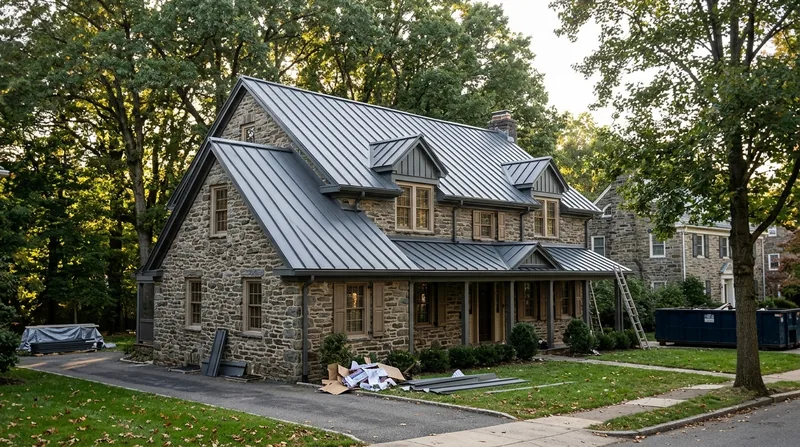




Standing Seam Metal Roofing in Philadelphia
Philadelphia sits on the Delaware River coastal plain, with the Schuylkill and Wissahickon valleys cutting through rolling Piedmont hills, and that mix of rowhouse blocks, Victorian twins, and stone Colonials demands a roof system that handles ice dams, nor'easters, and humid summers without failing. Standing Seam Metal Roofing in Philadelphia gives you concealed fasteners, roll-formed panels, and a roof that sheds snow and rain cleanly where 1800s brick rowhouses and 1920s twins have been fighting the weather for a century. We install panels formed to length on site, so the runs fit mansard fronts, bay windows, and porch roofs without a seam in the wrong place. If you are weighing a full replacement, start with our metal roof replacement service to see how we sequence tear-off and panel install. Call (267) 715-9723 and we will walk your roof before we quote a number.
Why Standing Seam Makes Sense on Philadelphia Roofs
Most of the housing stock here was built before 1950, and the dominant failure mode is water backing up at valleys, chimneys, and low-slope porch roofs during freeze-thaw cycles. Exposed-fastener panels loosen under that punishment, but a mechanically seamed standing seam roof has no screws to back out. In Germantown and Mount Airy, the Wissahickon schist walls and slate roofs on Victorian twins take a standing seam porch or dormer cap without losing the historic look. In Fishtown and Queen Village, a standing seam mansard or bay roof replaces failing built-up roofing with a system that handles summer thunderstorms and wet heavy snow.
- Concealed clips let the panel float, so it does not oil-can or tear at fasteners when temperatures swing from 95°F to single digits.
- Mechanically seamed panels resist wind uplift from nor'easters and remnant tropical storms far better than screw-down systems.
- Smooth panels shed leaves from the London planes, maples, and oaks that crowd Philadelphia street trees, keeping gutters clearer.
- Panels roll-formed to length eliminate end laps on long runs over rowhouse bays and twins.
If your current roof is at the end of its life, a standing seam install is the last roof you will likely put on that structure.
Key info: On a 1920s brick twin in Roxborough, we replaced a rusted porch roof with 24-gauge standing seam in a dark bronze finish, and the homeowner stopped getting ice dams at the bay window because the panels shed snow instead of holding it. Roofing permits are commonly required for a full replacement in Philadelphia, and thresholds vary by jurisdiction, so always verify with the local building department. You can check the City of Philadelphia's permit guidance at phila.gov before work starts.
How We Install Standing Seam on Delaware Valley Homes
We start by measuring the actual roof, not the drawing, because rowhouse bays, mansard fronts, and Victorian dormers rarely match a plan. Panels are roll-formed on site to the longest practical length, which cuts seams and end laps. We then set underlayment, clip spacing, and flashing details around chimneys and skylights before the first panel goes down. On stone Colonials in Chestnut Hill and Main Line estates, we match panel profile and color to the historic trim so the roof reads as original rather than added.
- We inspect the deck and framing, then replace rotten sheathing before any panel is cut.
- We install high-temp underlayment and ice-and-water shield at valleys, eaves, and chimneys.
- We set concealed clips at the spacing the panel manufacturer requires for local wind and snow loads.
- We roll-form panels to length and mechanically seam or snap-lock them according to the profile.
- We finish pan flashing, counterflashing, and ridge caps, then test the whole roof with a hose at the penetrations.
Every run is checked for straightness and clip engagement before we call the roof done.
Key info: A 1950s Levittown ranch in Bucks County had a low-slope addition where shingles kept blowing off in nor'easters. We installed snap-lock standing seam over new underlayment, and the panels have held through three storm seasons. If you are in the 19107 ZIP code, see our Center City standing seam page for neighborhood-specific details.
Standing Seam Approaches We Use
Not every Philadelphia roof wants the same panel. We match the seaming method and profile to the pitch, the building, and the budget, and we tell you plainly when a snap-lock panel is the right call and when a mechanically seamed panel is worth the extra labor.
| Approach | Description | Best for |
|---|---|---|
| Mechanically seamed | Double-locked seams formed with a seaming tool after panels are clipped in place. | Low-slope porch roofs and mansards where wind uplift and watertightness matter most. |
| Snap-lock | Concealed clips with a snapped seam, no field seaming tool required. | Steeper residential roofs on twins and Capes where budget and speed both count. |
| Roll-formed to length | Panels formed on site to the exact run, eliminating end laps. | Long rowhouse runs and farmhouse roofs in Chester and Montgomery County. |
| Standing seam over existing deck | New underlayment and clips set after tear-off, deck repaired as needed. | Full replacements where the sheathing is sound and the homeowner wants a clean slate. |
We will tell you which approach fits your pitch and your budget before you commit.
Standing Seam Metal Roofing Cost in Philadelphia: What to Expect
Most standing seam work in Philadelphia starts around $10 per square foot for materials and basic installation, and the final number depends on panel gauge, seam type, roof complexity, and how much deck repair your house needs. A simple porch roof on a Fishtown rowhouse sits at the low end; a mansard with multiple valleys and chimney flashing on a Queen Village property moves up. Access matters too: a narrow South Philadelphia alley means we hand-carry panels, and a steep Victorian roof in Mount Airy takes more labor than a low-slope addition.
Two or three estimates is the right way to compare. Ask each contractor what gauge they use, whether the panels are roll-formed on site, and how they handle flashing at chimneys and skylights. Our full pricing overview breaks down the ranges so you can read each bid against the same baseline.
Hiring a Standing Seam Metal Roofing Contractor Near Me in Philadelphia
Standing seam is a specialty, and not every roofer who hangs shingles can seam a panel correctly. Ask for the contractor's license and insurance certificate, and confirm the coverage is current before anyone gets on your roof. Check references from jobs in Philadelphia and the surrounding counties, ideally on a roof type similar to yours. Ask who pulls the permit, because a full replacement commonly requires one and the rules vary by jurisdiction. If you are in a historic district or an HOA, confirm the panel profile and color will pass design review before you order material.
Get at least two or three written estimates, and compare scope line by line, not just the bottom number. When you are ready to talk through your roof, contact us for a free estimate and we will schedule a walk-through.
Standing Seam Metal Roofing in Philadelphia: Pricing Guide
| Service | Price | Details |
|---|---|---|
| Snap-lock standing seam, simple roof | Starting at $10/sq ft | Includes panels, clips, underlayment and basic flashing on straightforward residential pitches. |
| Mechanically seamed panels | Starting at $14/sq ft | Adds field seaming labor and heavier clips for low-slope and high-wind exposures. |
| Complex roof with valleys and dormers | On estimate | Mansards, bay windows and multiple chimneys need an on-site look before pricing. |
| Deck repair and sheathing replacement | On estimate | Rotten sheathing found at tear-off is priced per sheet after inspection. |
| Travel | Included | in Philadelphia and surrounding counties, no separate call-out or mileage fee |
| Estimate | Free | Response within 24h at (267) 715-9723, no obligation to book |
Indicative pricing, the exact cost depends on square footage, finish, and site access. Free personalized estimate within 24h at (267) 715-9723.


