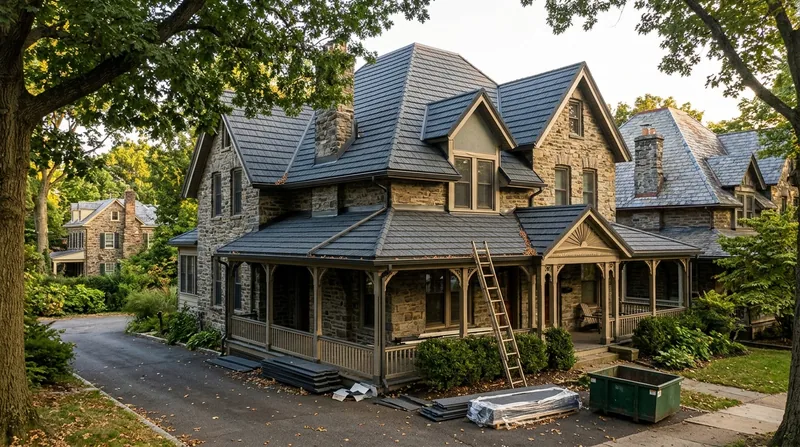




Stone-Coated Steel Roofing in Philadelphia is the system we install most often on the Victorian twins of Germantown, the stone Colonials of Chestnut Hill, and the 1920s brick Cape Cods across Roxborough and the Northeast. It pairs a galvanized steel core with a granule-coated finish that reads as slate or wood shake from the street, which matters on a block where neighbors still have original Vermont slate or cedar. The panels carry Class A fire rating and Class 4 impact resistance, so a July hailstorm over the Schuylkill valley does not punch through the way it does on aging three-tab. At roughly a quarter of the weight of real slate, it goes onto 100-year-old rafters without a structural retrofit. We install it on steep slopes, mansard fronts, and porch roofs where a standing seam profile would look wrong. For a Philadelphia homeowner tired of patching shingles after every nor'easter, this is a permanent answer. See how it fits our broader metal roof installation program.
Why Stone-Coated Steel Fits Philadelphia's Roofline and Weather
Philadelphia sits on the Delaware River coastal plain, with the Schuylkill and Wissahickon valleys cutting through the Piedmont hills to the north and west. That means hot, humid summers with severe afternoon thunderstorms and occasional hail, followed by nor'easters, remnant tropical storms, wet heavy snow, and repeated freeze-thaw cycles at the eaves. On a 1920s brick twin in Mount Airy, the failure we see most is not the field of the roof, it is the valleys, chimney flashing, and the ice dam that forms behind a dormer. Stone-coated steel handles all three better than asphalt because the interlocking panels shed water at the seam and the granule surface resists granule loss and moss streaking.
- It sheds heavy wet snow and ice without the shingle curl you get after ten winters on a north-facing slope.
- The Class 4 impact rating resists hail dents and granule loss that total a three-tab roof in one storm.
- The textured slate and shake profiles match the historic look on Queen Village, Fairmount, and Chestnut Hill blocks.
- It weighs about a quarter of real slate, so 1800s rafters in Kensington and Fishtown do not need sistering.
- It goes over existing shingles in many cases, which cuts tear-off cost and landfill weight on a tight rowhouse lot.
We match the profile and color to the block, not to a catalog page, because a bright shake panel on a brick rowhouse row stands out for the wrong reason.
Key info: On a stone Colonial in Chestnut Hill with original cedar shake, we installed a stone-coated steel shake profile in a weathered gray. The owner kept the historic look, dropped the annual shake replacement, and gained Class A fire rating on a roof surrounded by mature oaks.
Before any full replacement, check the permit threshold with the City of Philadelphia Department of Licenses and Inspections at phila.gov, since re-roof rules and inspection requirements vary by district.
How We Install Stone-Coated Steel on a Philadelphia Roof
We start on the ground, not the roof. A stone-coated steel job on a Philadelphia rowhouse or twin is a sequence, and the sequence is what keeps the roof watertight through the next storm. We walk the property, check the deck from the attic where we can, and confirm whether the existing layers allow a retrofit or require a full tear-off. Then we order panels cut to the actual roof, not to a rough square count, because a mansard front and a bay window roof both waste material when you guess.
- We inspect the deck, rafters, and existing flashing, and we photograph anything that needs repair before the new roof goes on.
- We pull the permit where the jurisdiction requires one and schedule the inspection before we close up the roof.
- We tear off or prepare the existing surface, then install underlayment and ice-and-water shield at the eaves and valleys.
- We set the starter course, then lay the stone-coated panels in the manufacturer's sequence, locking each course into the one below.
- We cut and fit flashing at chimneys, skylights, dormers, and sidewalls, and we seal penetrations with metal, not caulk alone.
- We install ridge caps, then walk the roof and hose-test the valleys and flashing before we call it done.
Every job ends with a magnet sweep of the lawn and driveway, because a roofing nail in a Philadelphia alley tire is a call we do not want to get.
Key info: On a 1920s brick twin in Roxborough, the rear porch roof and the main roof met at a low-slope valley that had leaked for years. We rebuilt the valley with ice-and-water shield and new metal, then ran stone-coated steel in a slate profile across both planes, so the repair and the re-roof happened in one pass.
If your existing roof is sound enough, a metal roof over shingles can save tear-off cost, but only within the code limit on existing layers.
Stone-Coated Steel Roofing Options We Install in Philadelphia
Not every Philadelphia roof wants the same panel. A Victorian twin in Germantown with a steep main slope and a shallow porch roof needs a different approach than a Levittown ranch in Bucks County with a simple gable. We carry the profiles and the fastening methods that fit the housing stock here, and we tell you plainly which one your roof can take.
| Approach | Description | Best for |
|---|---|---|
| Slate-profile panels | Stone-coated steel stamped in a slate pattern with interlocking edges. | Victorian twins, stone Colonials, and historic-district homes in Germantown, Mount Airy, and Chestnut Hill. |
| Shake-profile panels | Textured wood-shake look with a heavier shadow line and granule finish. | Cape Cods, ranches, and suburban homes in the Northeast, Delaware County, and Bucks County. |
| Tile-profile panels | Clay-tile look in steel, for homes where a tile roof was original or desired. | Main Line stone estates and larger homes where a tile profile fits the architecture. |
| Retrofit over existing shingles | New panels installed over a prepared existing roof within the code layer limit. | Sound roofs on rowhouses and twins where tear-off access is tight or cost is a factor. |
| Full tear-off and re-deck | Removal of all existing layers, deck repair, new underlayment, then panels. | Older roofs with rot, multiple shingle layers, or a failed deck in Fishtown, Kensington, and South Philadelphia. |
Whichever profile you choose, the underlayment and flashing detail matter more than the panel color, and that is where cheap jobs fail first.
Stone-Coated Steel Roofing Cost in Philadelphia: What to Expect
Stone-coated steel pricing in Philadelphia starts around $9 per square foot installed, and that figure is a starting point, not a quote. The number moves with the roof's complexity, the number of valleys, dormers, and chimneys, the pitch, and whether we tear off or retrofit. A simple gable on a Levittown ranch sits near the low end. A Victorian twin with a mansard front, two dormers, and a porch roof sits well above it, because every one of those planes is a separate flashing and cutting job.
Access matters as much as size. A rowhouse in South Philadelphia with a shared alley and no driveway means we carry materials by hand and stage on the street, which adds labor. A Main Line estate with a wide lawn and a clear driveway is faster. Height, tree cover, and the condition of the deck all push the number up or down, and we would rather tell you that on site than guess from a satellite photo.
Get two or three estimates, and make sure each one states the panel manufacturer, the underlayment, the flashing detail, and whether the price includes permit and disposal. A low bid that skips ice-and-water shield at the eaves is not a lower price, it is a smaller scope. Our full pricing overview breaks down what each tier includes.
Hiring a Stone-Coated Steel Roofing Contractor Near Me in Philadelphia
The Philadelphia metal roofing market has good crews and plenty of storm chasers, and the difference shows up two winters after the job. Start with the license and insurance certificate, not the brochure. Ask for the certificate of insurance directly from the carrier, and confirm the company carries general liability and workers' compensation. A crew on your roof without workers' comp is your liability if someone falls.
Get at least three written estimates with the same scope so you can compare them line by line. Ask for two recent references in Philadelphia or Delaware County and call them. Confirm who pulls the permit, because a full replacement in the city usually requires one, and historic district or HOA design review can restrict panel profile and color on homes in Old City, Queen Village, or a Bucks County subdivision. Finally, ask what happens if a panel is damaged in a storm: a real contractor has the manufacturer's warranty paperwork and a service number.
Reach us through the contact page or call (267) 715-9723 to schedule a free estimate.
Stone-Coated Steel Roofing in Philadelphia: Pricing Guide
| Service | Price | Details |
|---|---|---|
| Simple gable roof, retrofit | Starting at $9/sq ft | Includes panels, underlayment, and standard flashing on a straightforward gable; pitch and existing layers move the rate. |
| Complex roof with valleys and dormers | Starting at $12/sq ft | Covers multiple planes, valley metal, and dormer flashing; number of penetrations and roof height drive the price up. |
| Full tear-off and re-deck | On estimate | Needs an on-site look because deck condition, layer count, and disposal access vary block by block in Philadelphia. |
| Historic profile or custom color | On estimate | Special-order panels and design review add lead time and cost; we confirm the profile before quoting. |
| Travel | Included | In Philadelphia and surrounding areas, no separate call-out or mileage fee. |
| Estimate | Free | Response within 24h at (267) 715-9723, no obligation to book. |
Indicative pricing, the exact cost depends on square footage, finish, and site access. Free personalized estimate within 24h at (267) 715-9723.


